
Real-space Wannier Orbital Population analylsis
In 2010, Joydeep Bhattacharjee et al published a paper titled “Wannier orbital overlap population (WOOP), Wannier orbital position population (WOPP) and the origin of anomalous dynamical charges” Phys. Chem. Chem. Phys., 2010, 12, 1564–1570. In which, they proposed a method to decompose certain real-space observables (e.g., charge, dipole moment) into contributions from atomic-like Wannier orbitals (AOs) and molecular-like Wannier orbitals (MOs).
This method serves as an direct extension of the Crystal Orbital Hamilton Populations (COHP) and Crystal Orbital Overlap Populations (COOP) methods (see, for example, J. Phys. Chem., 1993, 97 (33), 8617–8624.), which are done in energy space.
In this post, I will briefly introduce the theory behind WOOP and WOPP and show how to use them with Wannier basis (for both AOs and MOs) to decompose the Born effective charge (BEC) of a ferroelectric material PbTiO3.
Wannier function $\phi_n$ sitting in cell $\mathbf{R}$ is defined as
where $\psi_{\mathbf{k}, m}$ is Bloch states at $\mathbf{k}$ point and band number $m$, $U$ is a unitary matrix that mixes the Bloch states. The constraint here is that $U$ needs to be square, meaning the number of $m$ needs to be the same as $n$. orbital-like Wannier functions by setting $m$ to also include the anti-bonding like states in the unoccupied manifold.
The main goal of WOOP and WOPP is to decompose Wannier charge and dipole which are usually described by molecular-like Wannier orbitals (MOs) using a set of atomic-like Wannier orbitals (AOs).
Here, unlike what Joydeep et al did, the AOs and MOs are all Wanneir functions from the same set of Bloch functions (MOs are restricted to be occupied Bloch states only and AO uses some empty bands). This means that the AOs forms a orthonormal basis, i.e., $S$ is identity. Because of this, the projection coefficients $C$ are simply $$
Again, because the AOs and MOs are all Wanneir functions from the same global set of Bloch functions, the underlying basis (Bloch states) is the same, and the $U$ matrix for the MOs can be zero-padded to be the same shape as $U$ matrix for the AOs. Hence,
Note that here $I$ and $m$ are composite indices that also specifies which cell does these Wannier functions sits $R_m$ and $R_l$.
Wannier Orbital Overlap Population
With $C$ calculated, the charge of a Wannier functions carries can be expressed as
With $C$ calculated, $\rho^I$ can be decomposed into the Wannier Orbital Overlap Population (WOOP) $B_{lm}^I$
Here, because AOs form an orthonormal basis, $B^I$ is a diagonal matrix. Remember MOs $W$ describes only the occupied bands, the total charge of the system can be represented as
Wannier Orbital Position Population
Similar to Wannier charge, the Wannier charge centre (WCC)
can be decomposed into the Wannier Orbital Position Population (WOPP) $D_{lm}^I$,
and $\sum_{l,m} D_{lm}^I$ should give $\braket{\mathbf{r}}_I$.
BEC decomposition
The electric contribution to the dipole moment can be The electric contribution to the dipole moment can be obtained from WCC
where the factor $-2$ comes from the fact that electron has negative charge and
each Wannier function can be occupied by two electrons. Note that here
$\mathbf{d}$ has the unit of abs(electron)Å. The total dipole moment is:
where $\mathbf{d}^\mathrm{ion.}$ is the ionic contribution.
For periodic system, the centro-symmetric contribution needs to be subtracted from teh
We are now ready to derive the Born effective charge (BEC) tensor $Z$
where $\mathbf{u}_{\kappa, j}$ denotes the distortion of atom $\kappa$ along direction $j$, and $\mathbf{d}_i$ is the induced change in the total dipole moment.
Assuming the ferroelectric distortion is within the linear regime, the derivative can be discretised as
We can express $\mathbf{d}$ with WOPP $D$
and $Z^\mathrm{elect.}_{\kappa,ij}$ can be further decomposed as
where depending on which atom $l$ and $m$ belongs to, we can identify specific contributions to the BEC and gain more insights into the origin of ferroelectrics.
Test case: PbTiO3
Codes and Inputs
All codes and inputs used for this test case: PTO_WOOPs.tar.gz
The band features of PbTiO3 looks like
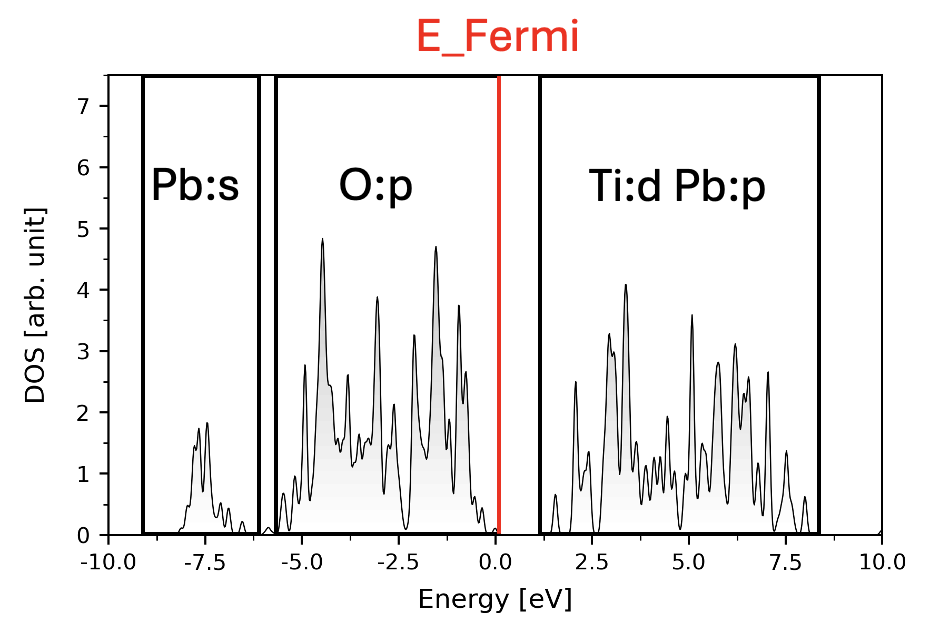
In this case, for MO, all Bloch bands between -10 and 0eV are used and projection are made onto Pb’s s-orbital and O’s p-orbitals. For AO, all Bloch bands between -10 and 9eV are used and projection are made onto Pb’s s-orbital, O’s p-orbitals, Ti’s d-orbitals and Pb’s p-orbitals.
With our Wannierzation strategy set, we Wannierized both centrosymmetric and Ti-displaced PTO structures.
First of all, let’s take a look at the Wannier centres of both centrosymmetric
---------------------------------------------------------------------
ELECTRONIC PART

Centro symmetric:
WF centre and spread    1  ( -0.000000, -0.000000, -0.000000 )
WF centre and spread    2  (  1.944478,  1.944478,  0.000000 )
WF centre and spread    3  (  1.944478,  1.944478,  0.000000 )
WF centre and spread    4  (  1.944478,  1.944478,  0.000000 )
WF centre and spread    5  (  0.000000,  1.944478,  1.944478 )
WF centre and spread    6  (  0.000000,  1.944478,  1.944478 )
WF centre and spread    7  (  0.000000,  1.944478,  1.944478 )
WF centre and spread    8  (  1.944478,  0.000000,  1.944478 )
WF centre and spread    9  (  1.944478,  0.000000,  1.944478 )
WF centre and spread   10  (  1.944478,  0.000000,  1.944478 )
Sum of centres and spreads ( 11.666867, 11.666867, 11.666867 )

Ti-displaced
WF centre and spread    1  ( -0.000000, -0.000000, -0.002362 )
WF centre and spread    2  (  1.944478,  1.944478, -0.031280 )
WF centre and spread    3  (  1.944478,  1.944478, -0.076180 )
WF centre and spread    4  (  1.944478,  1.944478, -0.076180 )
WF centre and spread    5  (  0.000000,  1.944478,  1.947213 )
WF centre and spread    6  (  0.000000,  1.944478,  1.955115 )
WF centre and spread    7  (  0.000000,  1.944478,  1.955985 )
WF centre and spread    8  (  1.944478,  0.000000,  1.947213 )
WF centre and spread    9  (  1.944478,  0.000000,  1.955985 )
WF centre and spread   10  (  1.944478,  0.000000,  1.955115 )
Sum of centres and spreads ( 11.666867, 11.666867, 11.530624 )

diff in z [using wannier centre] : -2*(11.530624)- -2*(11.666867) = 0.272486 electron*A

---------------------------------------------------------------------
IONIC PART

CENT                    X          Y          Z          Normal charge
Atom:     Ti  Position: 1.9444779, 1.9444779, 1.9444779  4
Atom:     Pb  Position: 0.0000000, 0.0000000, 0.0000000  4
Atom:     O   Position: 1.9444779, 1.9444779, 0.0000000  4
Atom:     O   Position: 0.0000000, 1.9444779, 1.9444779  4
Atom:     O   Position: 1.9444779, 0.0000000, 1.9444779  4
total_moment            23.333734, 23.333734, 23.333734


FE                      X          Y          Z          Normal charge
Atom:     Ti  Position: 1.9444779, 1.9444779, 2.0444779  4
Atom:     Pb  Position: 0.0000000, 0.0000000, 0.0000000  4
Atom:     O   Position: 1.9444779, 1.9444779, 0.0000000  4
Atom:     O   Position: 0.0000000, 1.9444779, 1.9444779  4
Atom:     O   Position: 1.9444779, 0.0000000, 1.9444779  4
total_moment            23.333734, 23.333734, 23.733735

diff in z [using ionic position] : (23.733735)-(23.333734) = 0.4 electron*A
With both the electronic part and ionic part of the dipole moments, the final total dipole moment is
Total polarization: (P(ION)+P(ELECT))/(cell_volume) = 0.672486 electron*A / 58.8165 A^3
With WOPP, we can check if it reproduces the WCCs using the following codes
import h5py
import numpy as np

#READ
dist = 0.1 #\Angstrom

opf = h5py.File("WAN_MAT_FE.h5", "r")
WOPP_FE = opf['WOPP'][:]
opf.close()

opf = h5py.File("WAN_MAT_CENT.h5", "r")
WOPP_CENT = opf['WOPP'][:]
opf.close()

# reproduce Wannier centers
# FE
WCC_FE = []
for i in range(10):
    WCC_FE.append([np.sum(WOPP_FE[0,i]).real,np.sum(WOPP_FE[1,i]).real,np.sum(WOPP_FE[2,i]).real])
    print(np.sum(WOPP_FE[0,i]).real,np.sum(WOPP_FE[1,i]).real,np.sum(WOPP_FE[2,i]).real)
# CENT
WCC_CENT = []
for i in range(10):
    WCC_CENT.append([np.sum(WOPP_CENT[0,i]).real,np.sum(WOPP_CENT[1,i]).real,np.sum(WOPP_CENT[2,i]).real])
    print(np.sum(WOPP_CENT[0,i]).real,np.sum(WOPP_CENT[1,i]).real,np.sum(WOPP_CENT[2,i]).real)
and we get
-----------------------------------------------------------------
FE
WF centre 0.005457029803540602  0.0054570297773970195 0.004255264833346661
WF centre 1.9447789431382763    1.9447789431340554   -0.030624440288172627
WF centre 1.937768439471597     1.941449120137218    -0.07843681899596507
WF centre 1.941449120219155     1.9377684394679062   -0.0784368191151973
WF centre 0.0009242643140386245 1.9417406120320475    1.9409903884146886
WF centre 0.0005663412429231772 1.945921535413768     1.9558120272283457
WF centre 0.0009764261688857814 1.9379821644723874    1.9536919910367032
WF centre 1.9417406119706437    0.0009242638801744313 1.9409903883589483
WF centre 1.9379821645546589    0.0009764261274046967 1.953691990879517
WF centre 1.9459215354391581    0.0005663413290268558 1.9558120270123225

-----------------------------------------------------------------
CENT
WF centre 0.0056661899212342255  0.005666189903008093   0.00565587885084541
WF centre 1.9449951440216728     1.9449951440185393     0.0015071280882127907
WF centre 1.9379484431461589     1.941643063427853      0.0009849934888696372
WF centre 1.941643063449559      1.9379484431173157     0.000984993502376968
WF centre 0.0009897481803453805  1.9416310929621265     1.9379595711051945
WF centre 0.00024483995096022306 1.9460389254623531     1.9448450213758401
WF centre 0.0009970042526089658  1.937943962970781      1.9416336872564393
WF centre 1.9416310929120248     0.000989748185270458   1.9379595709880377
WF centre 1.937943962977724      0.0009970042511571067  1.9416336873355562
WF centre 1.9460389254168549     0.00024484000013661345 1.9448450213530668
we see that the total dipole moment is properly reproduced and the total dipole moment along z-axis calculated using WOPP is:
Total_dipole 0.28052710795980484 ```
Taking a look at `completeness.txt` generated from running `woops.py`, we also
find all MOs are perfectly reproduced with AOs hence they are normalised and the
total number of charge is conserved.
With this script
[get_z.py](/assets/other/2026-01-08-WOOP/get_z.py) (which
requires `WAN_MAT_CENT.h5` `WAN_MAT_FE.h5`), the BEC is decomposed using
WOPPs.
Focusing on MO_2:
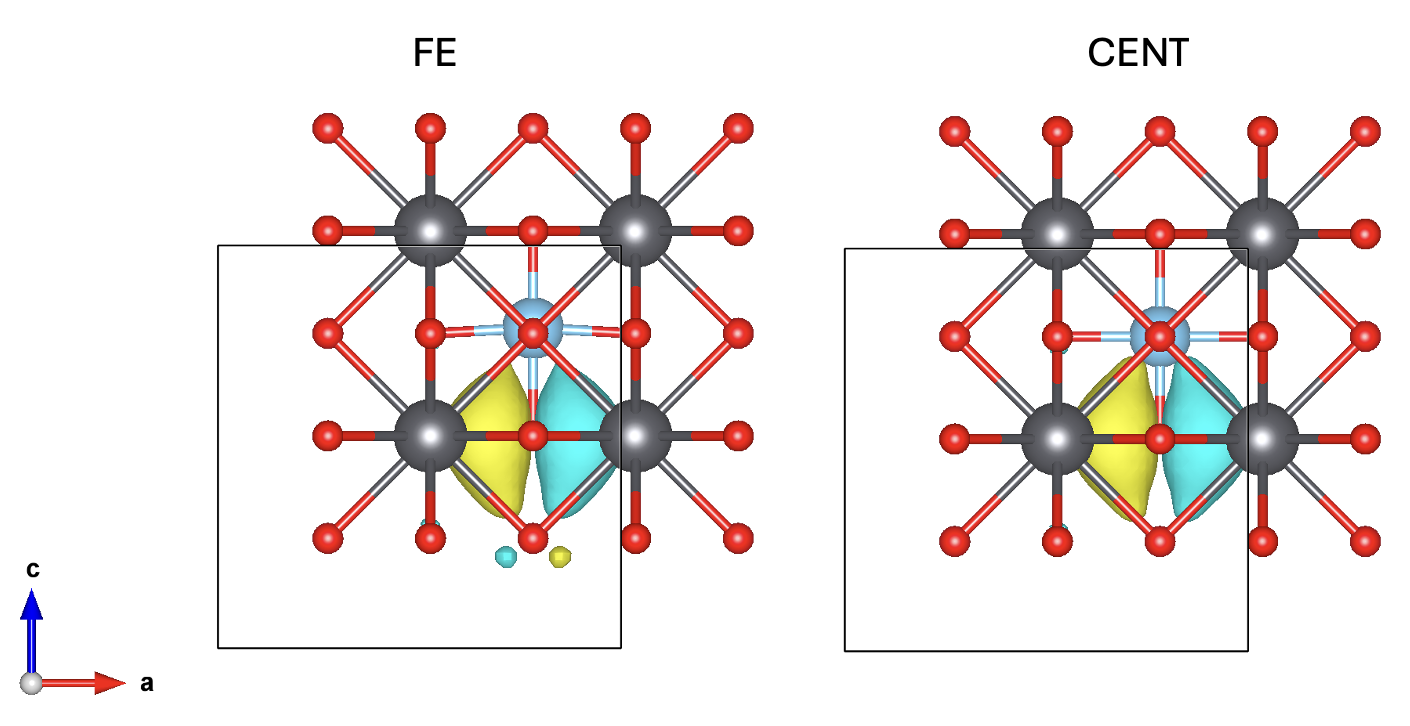{:height="70%" width="70%" .center}
The WOPP decomposition of $Z$ of MO_2 is:
Atom: 2 MO: 2 CT: 1.8900887213008697 LP: -0.0009889066762047358 COV: -0.28750406100028203 NC: -0.04753727747447927 ```
where CT is charge transfer, LP is local polarizability, COV is
covalency and NC is non-local contribution (see Fig.3 of
reference).
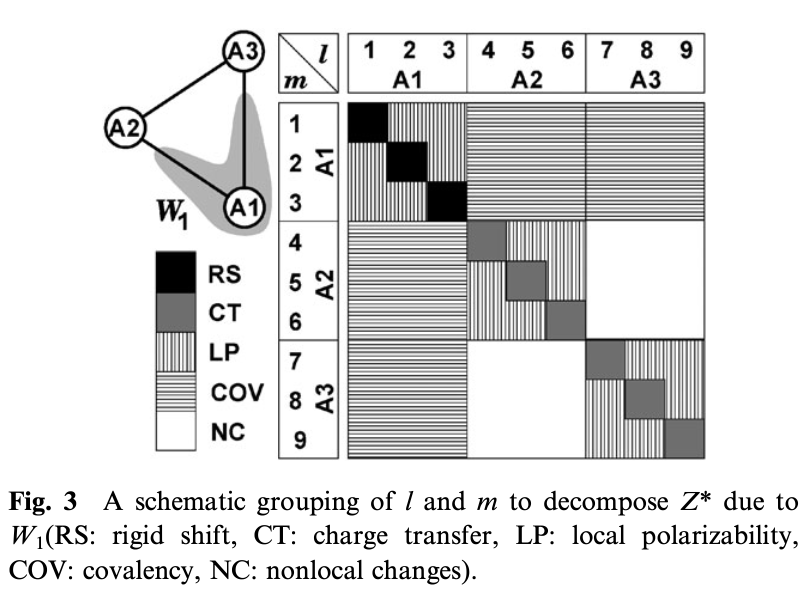
we see that indeed as described in the reference, the major contribution comes from charge transfer from O to Ti.
Codes and Inputs
All codes and scripts used in this post are available in the following GitHub repository: https://github.com/Chengcheng-Xiao/WOOPs.